
Freedom and Harm: Where Do Individual Rights End?
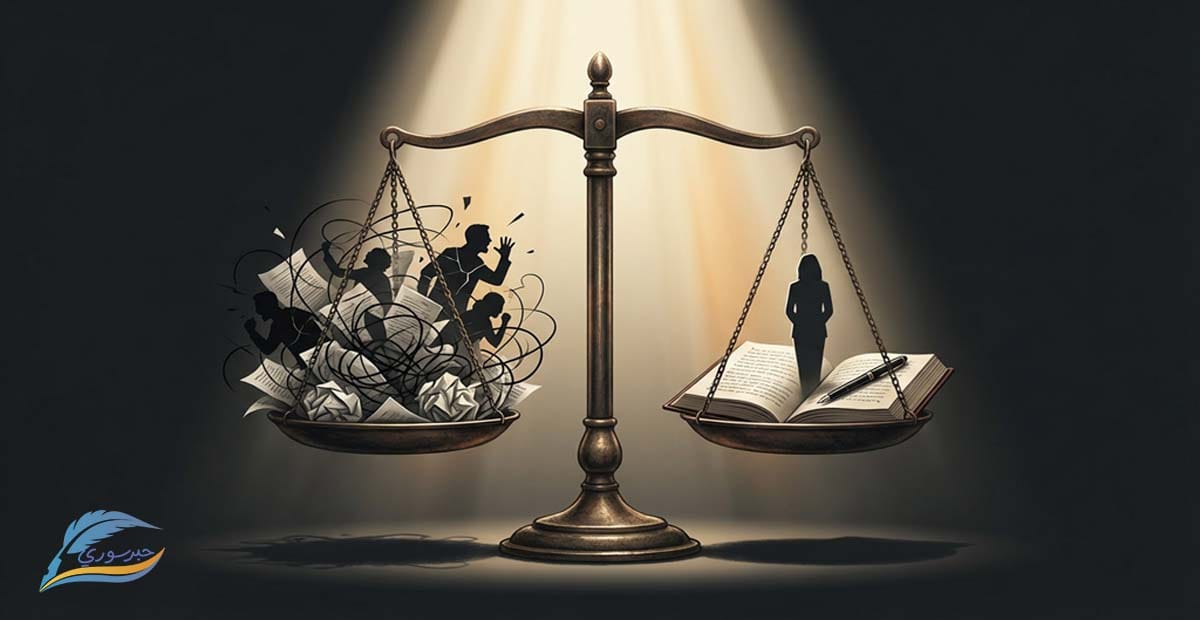
In public debates in Syria today, one sentence is repeated more than almost any other: “Your freedom ends where the freedom of others begins.” It is sometimes used to defend freedoms, sometimes to restrict them, and sometimes to shut down discussion altogether. Yet in reality, it is not a complete rule but a simplified attempt to explain a far more complex idea.
The real issue lies not in the phrase itself, but in the meaning of “harm.”
When does an individual’s action become an infringement on society? And when is it simply a difference?
The confusion here is widespread. Not everything that disturbs people is an infringement, not everything that contradicts custom is a danger, and not everything the majority dislikes is a threat to public order. Modern societies do not measure freedom by the level of psychological comfort others feel, but by the existence of actual, direct, identifiable harm.
If someone disagrees with you, they are not violating you.
If someone dresses in a way you dislike, they are not taking away your rights.
If someone expresses themselves, they are not preventing you from expressing yourself.
But if someone denies you your rights, threatens your safety, incites violence against you, or assaults you — this is where the limits of freedom begin.
For this reason, in stable legal systems, restrictions on freedoms are not based on “offense” but on demonstrable harm. Emotions change; rights are meant to be stable. When the standard for prohibition becomes public displeasure or social pressure, the rule ceases to be legal and becomes arbitrary.
Here the problem begins.
In societies emerging from long conflicts, a fear of chaos naturally appears. People want stability above all else, and authorities fear disorder. But freedom and chaos are often confused, as if expanding freedom automatically leads to the collapse of order.
Political experience suggests nearly the opposite.
Chaos does not begin when freedom expands, but when its boundaries become unclear.
When citizens do not know what is permitted and what is prohibited, when they see rules applied to one person and ignored for another, or when rules change depending on place or authority, society begins to create its own rules. And when people are forced to organize their lives outside the law, disorder truly appears.
Stability does not result from reducing freedom, but from clarifying it.
A citizen can live under a strict law if it is clear and applied to everyone, but cannot live with a vague law even if it is lenient, because ambiguity creates a permanent sense of insecurity. The danger is not fear of punishment, but fear of unpredictability.
This is why the common phrase sometimes becomes counterproductive.
Instead of defining the limits of freedom, it is used to expand prohibition — once in the name of morality, once in the name of tradition, and once in the name of protecting society. The issue then ceases to be a relationship between equal rights and becomes a relationship between social authority and the individual.
Society does not need protection from difference, but from harm.
And the state is not measured by its ability to control behavior, but by its ability to protect rights.
Freedom is not that everyone does whatever they want, but neither is it that everyone must live the same way. The dividing line is not public taste or social approval, but the presence of clear, real harm.
When the standard of prohibition becomes what is said, what is preferred, or what pleases the majority, the discussion ceases to be legal and becomes moral — and freedoms gradually turn into privileges that can be withdrawn.
In the end, societies do not collapse because of freedom, but because of lost trust.
Trust is not built by shrinking space, but by a rule everyone understands:
What is my right, what is another’s right, and what no one has the right to violate.
Freedom is not tested when we agree,
but when we disagree and still remain able to live together.