A Syrian Journalist Between Assad-Era Repression and the Risk of Israeli Occupation
After the fall of Bashar al-Assad’s regime in Syria on 8 December 2024, journalist Nader Dabbou believed his life would finally change. For fourteen years he had worked under surveillance and constant threat. He assumed the collapse of Baath Party authority would open a new chapter. The reality proved different: fear did not disappear.
Following the regime’s collapse, Israeli forces announced they were no longer bound by the 1974 Disengagement Agreement and advanced into the demilitarized zone in southern Syria. There they established nine military bases along the border strip, expanding from them toward nearby villages and towns.
Since then, restrictions have been imposed on residents’ movement, especially farmers, and journalists have been prevented from working, greatly increasing the risks of field reporting.
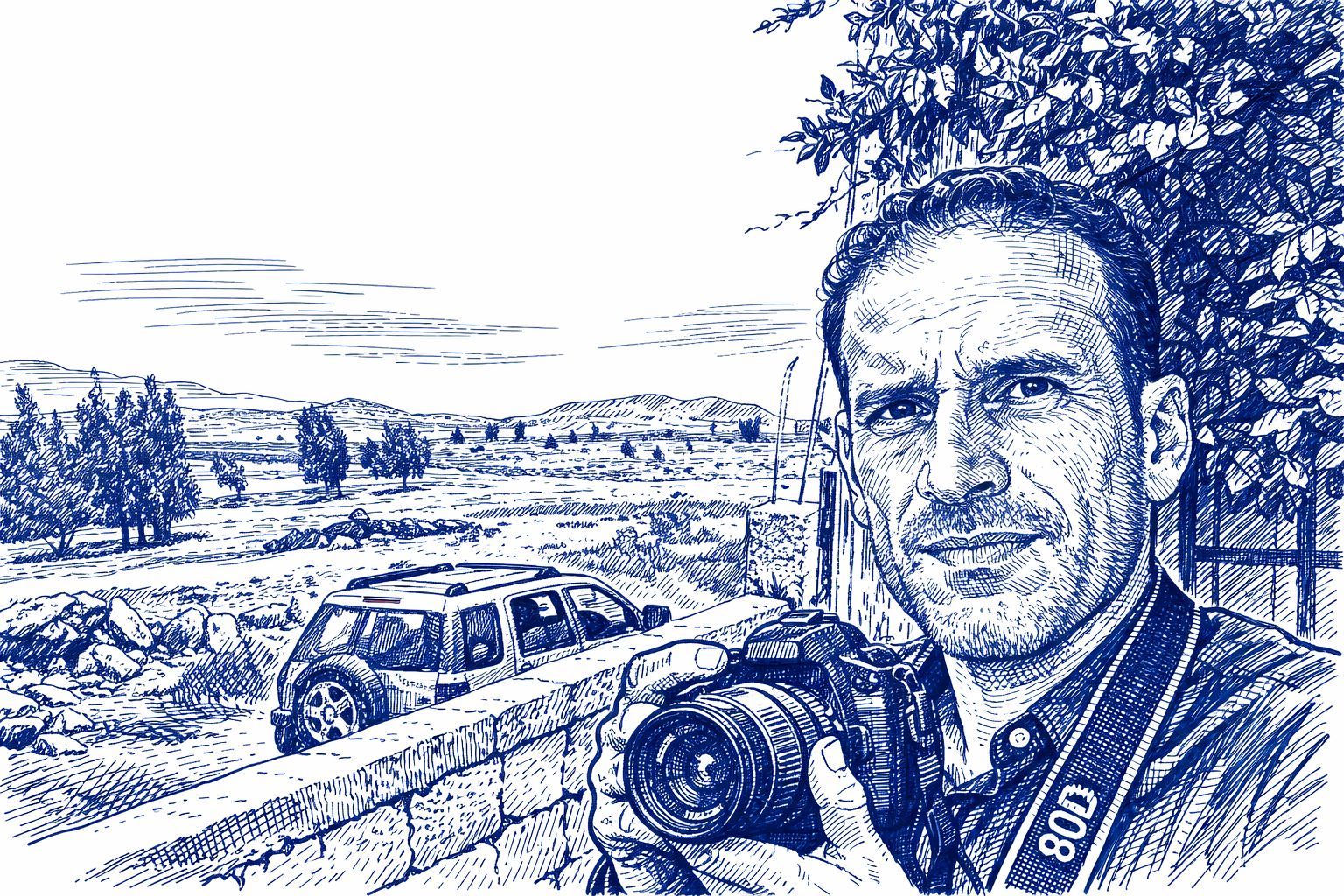
The journalist comes from the city of Nawa in Daraa province, less than 15 kilometers from areas where Israeli military bases are stationed. Every morning Nader takes dirt roads with his equipment slung over his shoulder. He is among the few journalists documenting these violations on the ground.
According to a report issued by the Committee to Protect Journalists (CPJ) on 8 August last year, Israeli forces committed multiple violations against Syrian and foreign journalists in southern Syria since late 2024. The Syrian Journalists Association also documented at least four serious incidents during the same period.
Reports point to cases of pursuit, detention and interrogation, direct gunfire, physical assaults, and confiscation or destruction of journalistic equipment. In some instances journalists were forced under threat to delete their material. One reporter was shot, while another sustained severe injuries following a beating.
After a long working day in Syria, Nader says, “There is no authority that protects journalists.” He spoke while switching off his motorcycle, its engine breaking the silence of the rural neighborhood where he lives.
On this motorcycle he heads toward Sweida in southern Syria to cover recent violence, and at other times westward to document Israeli incursions and their impact on civilians’ lives.
“The most institutions and journalist unions do is issue condemnation statements,” he says. “Real protection simply does not exist.”
Thirty-nine years old, Nader works for the newspaper +963, serves as a correspondent for Syria Monitor, and collaborates with RT France, France 24, and Radio France Internationale.
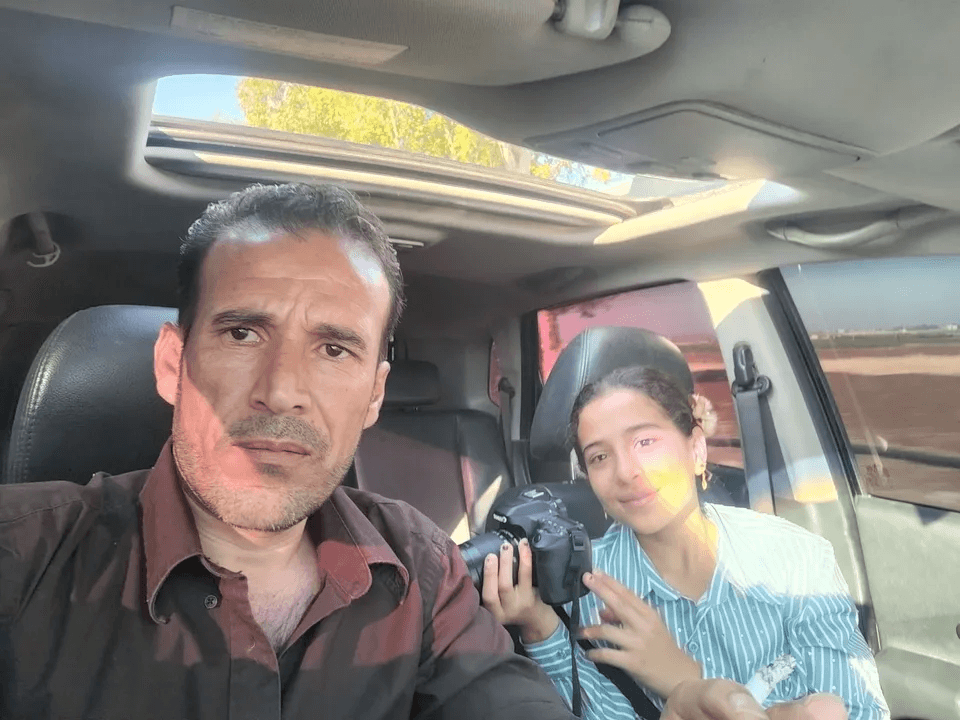
Nader Dabbou with his daughter Sham before leaving their home in Nawa for Damascus.
Hunting Journalists
On the morning of 14 June 2025, Nader did not use his motorcycle as usual. He rented a car and took his eleven-year-old daughter Sham on a family trip to Damascus. As always, he carried his camera. The trip did not last long. He received a call from the newspaper he works with: “The Israeli army has shot down an Iranian drone in Quneitra, southern Syria.” He had to go immediately.
He hurried back with his daughter toward rural Quneitra and met his journalist friend Nour Hassan from al-Rafid. In the town of Kodna, near the newly established Israeli military base at Tal al-Ahmar al-Gharbi, they took photographs and interviewed residents. Then a call from a local resident changed everything: “Israeli forces have entered the town searching for journalists.”
“We were inside the village while they were surrounding it,” Nader says. “Their vehicles began chasing our car, with me, my daughter, and my friend inside. I was afraid for myself, but more for my daughter — and for the images in the camera.”
He explains, his voice trembling despite an attempt to smile, that the camera contained footage from previous events. Losing it meant losing visual testimony and evidence of Israeli violations — and could lead to imprisonment, just as during years of repression under Assad, when journalistic work meant prison or death.
After more than thirty minutes of pursuit, they reached a temporary checkpoint. About 500 meters away, Nader threw the camera out of the car window into a field filled with thorns so it would not fall into soldiers’ hands.
“It was the hardest moment,” he says. “I was trying to save my daughter and the camera at the same time. In the end, she saved us all.”
Eight soldiers were waiting for them, including an officer who spoke fluent Arabic. They searched the vehicle carefully and interrogated the journalists. The officer said: “Don’t you know this is Israeli territory?”
Nader replied: “I thought it was Syrian — and that I should be the one asking you what you’re doing on my land.”
As tensions rose, his daughter Sham burst into tears. Her crying defused the situation. When the soldiers failed to find the camera, they allowed them to leave.
Hours later, after the military unit returned to its base, Nader went back to the field, recovered the camera from among the thorns and grass, cleaned it, and held it tightly, grateful it had survived.
When Does This Old Fear End?
Nader Dabbou began his journalistic work in 2011 with the outbreak of the Syrian uprising, documenting demonstrations in his area with his mobile phone under constant threat. Over time, he managed the media office of an opposition armed formation and later became a correspondent for local agencies, moving across areas outside regime control in southern Syria.
But the regime’s return with Russian support and the Moscow-brokered “reconciliation settlement” changed everything. Nader remained in his town, yet fear of arrest or assassination forced him to stop journalistic work for a year.
In 2019 he cautiously returned, cooperating with human rights documentation committees and the Syrian Center for Media and Freedom of Expression. He later worked under a pseudonym, documenting security raids and other regime violations.
Those were the most dangerous years of his life. He survived three assassination attempts — two shootings at his home and one on the road. Threats came from regime-affiliated militias, ISIS, and local militias linked to Iran.
With the fall of Bashar al-Assad, Nader felt he had regained his voice. He resumed working under his real name and with greater freedom. He has lost journalist friends — and could easily have been one of them. Yet he remains determined to continue.